
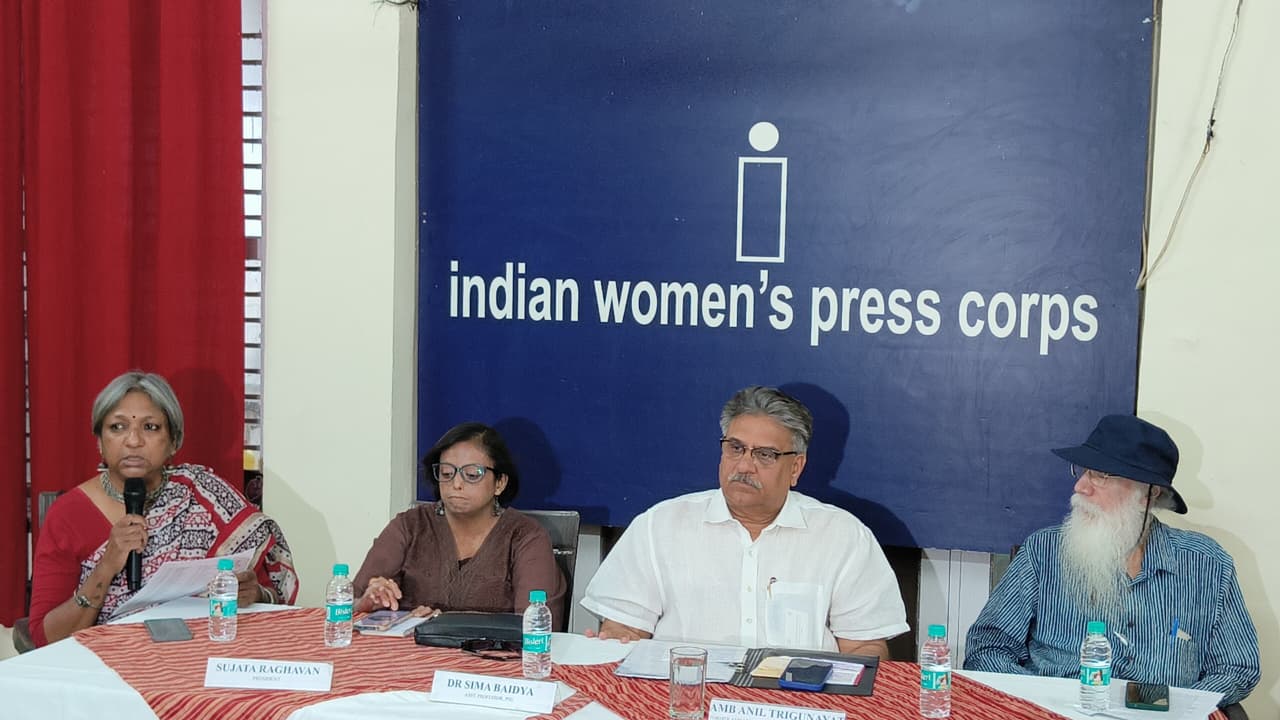
New Delhi: The Indian Women’s Press Corps (IWPC) organised a panel discussion on “Impact of West Asia Crisis on Indian Economy” on June 3 to examine the implications of the ongoing regional turmoil for the Indian economy.
The panelists included Prof. Arun Kumar, noted economist and former Professor at Jawaharlal Nehru University (JNU); Amb Anil Trigunayat, former Ambassador to Jordan, Libya and Malta; and Dr. Sima Baidya, Assistant Professor at the Centre for West Asian Studies, JNU.
Experts conceded that signs of economic distress have become increasingly evident in the declining value of the rupee, weak investor confidence, stagnant wages, and persistent inflation. The West Asia crisis has brought these vulnerabilities into sharper focus and further exacerbated them.
Expanding on this, Prof Arun Kumar said that a significant share of India’s crude oil imports originates in the region, any disruption to supply routes or spikes in prices would have wide-ranging consequences.
This affects only fuel prices, but a range of petrochemicals derived from crude oil that are the fundamental building blocks for thousands of everyday items. This would impact production costs of medicines and fertilizers etc., He stressed that while India has developed a degree of resilience in recent years, prolonged instability in West Asia could affect economic growth, investment flows and consumer demand.
While the immediate trajectory of the war remains unclear, Ambassador Trigunayat said India must remain vigilant and continue diplomatic engagement with all relevant stakeholders. He spoke about India’s long-standing efforts to diversify energy sources and build strategic partnerships beyond West Asia. “The region remains critical to India’s energy security and economic interests,” he said, pointing out that geopolitical instability has historically had ripple effects across global markets and warned that the current crisis could trigger further volatility if it escalates.
Dr. Baidya placed the conflict in its broader geopolitical context, describing the US-Israel attack on Iran as an imposed war with global implications. “Although India is not a direct participant in the conflict, it cannot remain unaffected by its consequences. India needs to have a strong voice that calls for a halt to the war.
Experts agreed that the country’s continued dependence on imported energy and its integration into the global economy make it susceptible to prolonged disruptions in West Asia. The need of the hour is diversification of energy supplies, strategic planning and sustained diplomatic efforts to mitigate potential risks.
NOTE: Click here hindi version ( PDF file)